
How To Use Wildcards In Excel Formulas
How To Use Wildcards In Excel Formulas - There are a lot of affordable templates out there, but it can be easy to feel like a lot of the best cost a amount of money, require best special design template. Making the best template format choice is way to your template success. And if at this time you are looking for information and ideas regarding the How To Use Wildcards In Excel Formulas then, you are in the perfect place. Get this How To Use Wildcards In Excel Formulas for free here. We hope this post How To Use Wildcards In Excel Formulas inspired you and help you what you are looking for.
“`html
Unleashing the Power of Wildcards in Excel Formulas
Excel formulas are powerful tools for data manipulation and analysis. While basic formulas perform simple calculations, more advanced formulas leverage functions and operators to perform complex tasks. One often overlooked yet incredibly useful aspect of Excel formulas is the incorporation of wildcards. Wildcards allow you to perform partial matches and search for text patterns within your data, significantly expanding the capabilities of functions like `SUMIF`, `COUNTIF`, `VLOOKUP`, `MATCH`, and `SEARCH`.
Understanding Excel Wildcards
Excel supports three primary wildcards:
- Asterisk (*): Represents zero or more characters. It can be used to match any sequence of characters, regardless of length. For example, “App*” would match “Apple,” “Application,” “App,” and even “Applesauce.”
- Question Mark (?): Represents a single character. It’s useful when you need to match a specific character in a known position. For example, “H?t” would match “Hat,” “Hit,” and “Hot,” but not “Heat.”
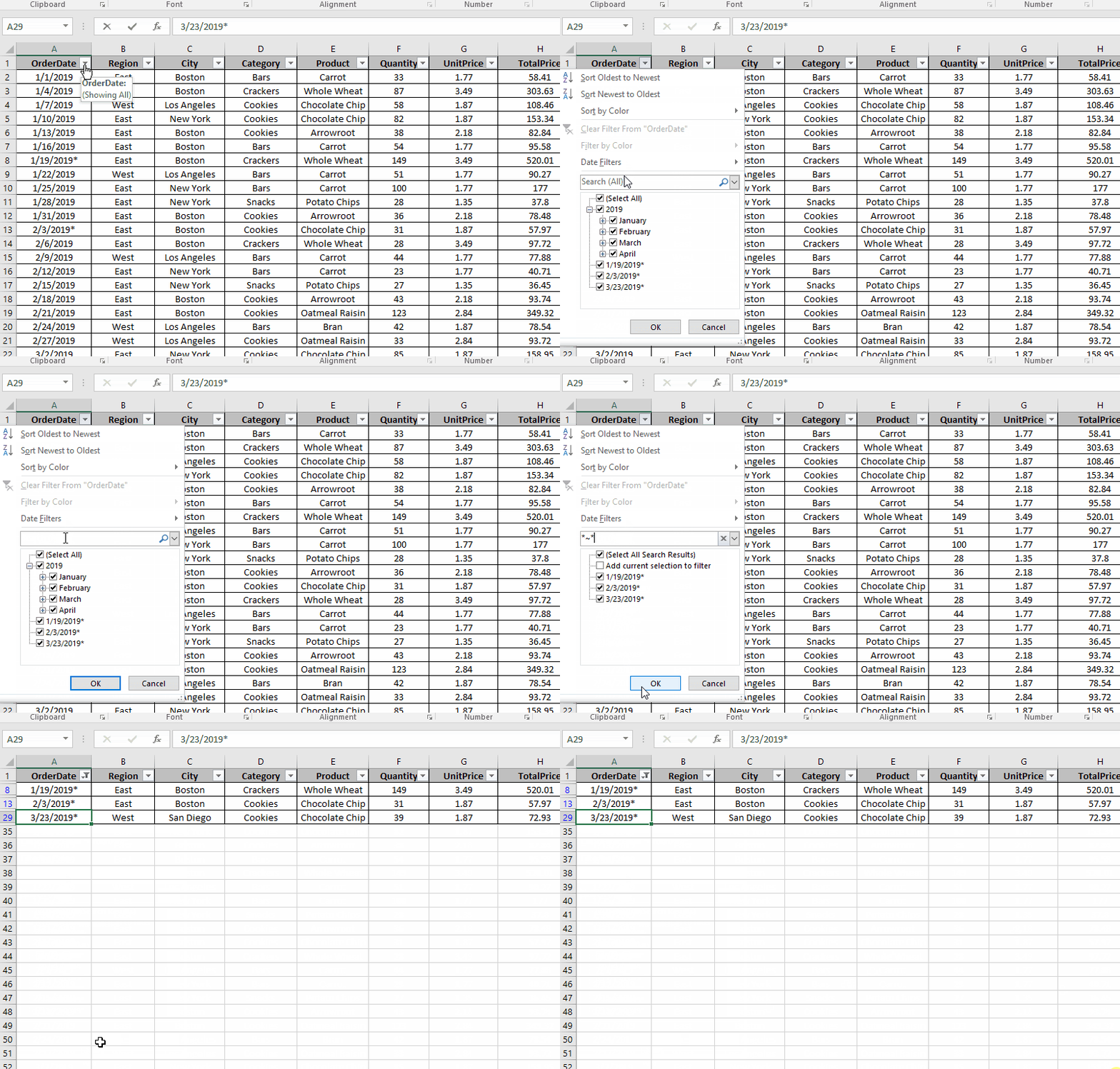
- Tilde (~): Used to escape the asterisk or question mark when you need to search for them literally. If you want to find cells containing an actual asterisk, you would use “~*”.
Wildcards in `SUMIF` and `COUNTIF`
`SUMIF` and `COUNTIF` are essential functions for conditional aggregation and counting. Wildcards enhance their ability to handle flexible criteria.
`SUMIF` with Wildcards
`SUMIF(range, criteria, [sum_range])` sums values in `sum_range` based on whether the corresponding cells in `range` match the `criteria`. Let’s consider a sales dataset:
| Product | Sales |
|---|---|
| Apple iPhone 14 | $999 |
| Apple iPad Pro | $799 |
| Samsung Galaxy S23 | $899 |
| Apple Watch Series 8 | $399 |
| Samsung Galaxy Tab S8 | $699 |
To calculate the total sales of all Apple products, you can use:
`=SUMIF(A1:A5,”Apple*”,B1:B5)`
Here, “Apple*” as the `criteria` matches any product name starting with “Apple,” effectively summing the sales of the iPhone, iPad, and Watch.
You can use multiple wildcards. For instance, if you want to sum the sales of products whose names contain “Galaxy” and end with a number:
`=SUMIF(A1:A5,”*Galaxy*?*”,B1:B5)`
This sums the sales of “Samsung Galaxy S23” and “Samsung Galaxy Tab S8” because “*Galaxy*” matches the “Galaxy” portion, and “*?*” ensures the name ends with at least one character (often a number in product naming conventions).
`COUNTIF` with Wildcards
`COUNTIF(range, criteria)` counts the number of cells in `range` that match the `criteria`. Using the same sales dataset, to count the number of products starting with “Apple”:
`=COUNTIF(A1:A5,”Apple*”)`
This returns 3, as there are three products (iPhone, iPad, and Watch) that begin with “Apple.”
To count the products with a name containing “Tab”:
`=COUNTIF(A1:A5,”*Tab*”)`
This returns 1, counting only “Samsung Galaxy Tab S8”.
Wildcards in `VLOOKUP` and `MATCH`
`VLOOKUP` and `MATCH` are powerful lookup functions. Wildcards allow for fuzzy matching when exact matches are not available or desired.
`VLOOKUP` with Wildcards
`VLOOKUP(lookup_value, table_array, col_index_num, [range_lookup])` searches for `lookup_value` in the first column of `table_array` and returns a value from `col_index_num` in the same row. To use wildcards effectively with `VLOOKUP`, you usually need to concatenate the wildcard with the lookup value using the `&` operator. Bear in mind that you have to set `range_lookup` to `FALSE` (or 0) for exact match, even when using wildcards.
Consider this employee data:
| Employee ID | Employee Name | Department |
|---|---|---|
| EMP123 | Alice Smith | Marketing |
| EMP456 | Bob Johnson | Sales |
| TEMP789 | Charlie Brown | IT |
| EMP101 | David Lee | Finance |
To find the department of an employee whose ID starts with “EMP”:
`=VLOOKUP(“EMP*”,A1:C4,3,FALSE)`
However, this will not work. `VLOOKUP` won’t automatically interpret “EMP*” as a wildcard pattern within the function directly. We can use `SEARCH` inside the formula to find the matching row.
A better alternative involves creating a helper column that indicates whether the Employee ID starts with “EMP”. Then you can look up the first `TRUE` in the helper column.
Another approach involves using a combination of `INDEX` and `MATCH` along with `SEARCH`: This is more complex but allows for more robust fuzzy matching.
`=INDEX(C1:C4,MATCH(TRUE,ISNUMBER(SEARCH(“EMP*”,A1:A4)),0))`
This formula searches for the first Employee ID starting with “EMP” and returns the corresponding Department.
`MATCH` with Wildcards
`MATCH(lookup_value, lookup_array, [match_type])` searches for `lookup_value` within `lookup_array` and returns its relative position. Similar to `VLOOKUP`, you typically need to concatenate the wildcard with the lookup value.
Using the employee data above, to find the row number of the first employee ID starting with “EMP”:
`=MATCH(TRUE,ISNUMBER(SEARCH(“EMP*”,A1:A4)),0)`
This formula finds the first cell in the range A1:A4 that *contains* “EMP” at the beginning and returns its position (which would be 1 in this case, because “EMP123” is in the first row.).
Wildcards in `SEARCH`
`SEARCH(find_text, within_text, [start_num])` finds the starting position of `find_text` within `within_text`. Wildcards are very useful with `SEARCH` for pattern matching.
Consider a list of email addresses:
- john.doe@example.com
- jane.smith@domain.net
- peter.jones@example.org
To find the starting position of any email address ending with “.com”:
`=SEARCH(“*.com”,”john.doe@example.com”)`
This returns 16, as “.com” starts at the 16th character. If “.com” isn’t found, it returns an error.
Escaping Wildcards
If you need to search for a literal asterisk or question mark, you must escape them with a tilde (~). For example, if you have data like:
- Value*1
- Value?2
To count cells containing “Value*”:
`=COUNTIF(A1:A2,”Value~*”)`
This correctly counts cells containing “Value*” instead of treating the asterisk as a wildcard.
Conclusion
Wildcards are a powerful addition to Excel formulas, enabling flexible pattern matching and significantly extending the capabilities of functions like `SUMIF`, `COUNTIF`, `VLOOKUP`, `MATCH`, and `SEARCH`. By understanding and mastering the use of asterisks, question marks, and the tilde for escaping, you can unlock a new level of data analysis and manipulation within Excel.
“`
 768×445 wildcards excel exceldemy from www.exceldemy.com
  700×400 excel formula wildcards exceljet from exceljet.net
  624×364 wildcards excel teachexcelcom from www.teachexcel.com
  806×514 wildcards from www.exceltip.com
  500×244 wildcards excel from www.exceltip.com
  700×400 excel wildcard exceljet from exceljet.net
 How To Use Wildcards In Excel Formulas was posted in January 4, 2026 at 11:22 pm. If you wanna have it as yours, please click the Pictures and you will go to click right mouse then Save Image As and Click Save and download the How To Use Wildcards In Excel Formulas Picture.. Don’t forget to share this picture with others via Facebook, Twitter, Pinterest or other social medias! we do hope you'll get inspired by ExcelKayra... Thanks again! If you have any DMCA issues on this post, please contact us!